
By Richard Clements
LifesQuest usually starts in a fairly straightforward way. We visit places that already hold our interest and spend time in them without rushing. Churches come up often, not because they are being sought out as subjects in themselves, but because they are familiar landmarks that tend to reward close looking. Over time, details begin to surface that are easy to miss on a first visit.
Earlier this week, after sharing some initial thoughts on medieval graffiti, Darryl and I decided to look for further examples for ourselves. This was not, strictly speaking, a psychic Quest in the usual sense. There was no specific question we were pursuing. Instead, it grew out of a recurring LifesQuest instinct: to follow an area of interest far enough to see what else might emerge.
That instinct took us a little further north than our usual area of activity, to St Mary the Virgin at Little Sampford, close to the Cambridgeshire border. The church is often mentioned in passing in discussions of medieval graffiti, and that alone made it a useful place to visit. We were not looking for anything extraordinary. We wanted to understand what people mean when they talk about church graffiti, and how visible or accessible it really is.
The church was open when we arrived, and we had it entirely to ourselves. As we often do, we split up and walked the interior separately at first, allowing space for individual impressions to form. There was a moment when it seemed as though the reputed graffiti might prove elusive. It soon became clear that this was not a matter of absence, but of where attention was being placed. Once the first marking was noticed, others followed quickly. At Little Sampford, much of the graffiti clusters around pillars, arches, and doorways, places that repay a slower way of moving through the building.
That visit provides the starting point for this article, but it is not its focus. What follows is a broader look at medieval church graffiti, why these markings exist, how they may have been viewed at the time, and why they are still worth noticing now.
The term “medieval graffiti” suggests a single category, but the reality is more uneven. The medieval period covers several centuries, and the markings grouped under this heading were made by different people, at different times, and for different reasons. Some may date to the twelfth or thirteenth century, others to the later medieval period, and many sit alongside early modern or later additions. They appear together on the same walls, added gradually, without any clear attempt to separate one period from another.
Common Forms and Imagery
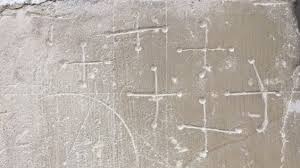
Crosses are one of the first things people tend to notice once they begin looking. Some are nothing more than two intersecting lines, while others show more care in their proportions. In a few places, the same form appears again and again. These are often understood as personal acts of devotion, made quietly and without ceremony. In some cases, the act of repeating the mark may have been as important as the symbol itself.
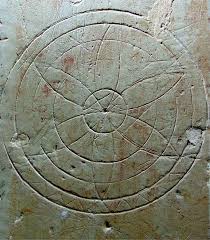
Compass-drawn circles also appear in many churches. These tend to stand out because of their precision. They are regular enough to suggest tools rather than chance. What they were intended to do is unclear. Some may relate to belief or protection, while others may reflect the habits or skills of people who worked regularly with stone.
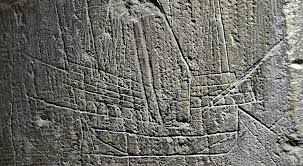
Ships are another image that appears from time to time, particularly in churches connected to rivers, trade routes, or coastal areas. Their meaning is not consistent. They may relate to journeys, danger, work, or survival, or simply reflect the concerns of the people who spent time in those buildings. A ship carved into stone could represent fear, hope, gratitude, or something more practical that is now lost to us.
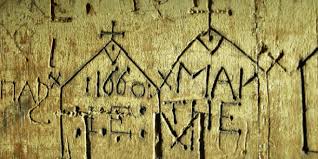
Initials, names, and dates are easy to overlook, but they still matter. Someone chose to mark their presence within the building, even if only briefly. Whether this was done out of devotion, habit, or convenience is often impossible to determine. What remains is a small record that someone was there.
Alongside these are animals, rough figures, abstract shapes, overlapping lines, and marks that do not fit neatly into any category. Some are easy to spot once you slow down. Others only become visible when the light falls at a certain angle. In many cases, uncertainty is unavoidable.
Placement, Authority, and Attitude
The position of graffiti is rarely accidental. Doorways, arches, pillars, and thresholds attract repeated marking. These are places people pass through or pause near, rather than stand still. This naturally raises the question of how such marking was viewed at the time.
Ideas of vandalism as we understand them today do not map neatly onto the medieval world. Churches were not treated as finished objects that needed to remain unchanged. They were working buildings, repaired and altered as needed. Walls were whitewashed and reworked, stone was replaced, and surfaces changed over time. Within that setting, a small scratched mark was not automatically seen as damage.
There is little indication that church authorities actively encouraged this kind of marking, but there is also little evidence of sustained attempts to stop it. For much of the medieval period, familiar and unobtrusive symbols appear to have been accepted as part of how people used church spaces. Private acts of belief existed alongside official teaching, and a scratched cross or symbol could function as a personal gesture rather than an act of defiance.
Some markings, particularly precise geometric ones, may have been made by people working on the building itself. In those cases, marking stone would have been part of everyday practice rather than something out of bounds.
It is unlikely that most people making these marks believed they were doing something improper. Attitudes towards sacred space were more flexible than they are now. The stone of the church mattered, and interacting with it physically could carry meaning. The boundary between building and person was less rigid.
Attitudes did change over time. By the later medieval period, and especially after the Reformation, unofficial marks could become less acceptable, particularly if they were associated with older devotional practices or folk belief. This helps explain why some graffiti was later covered over or partially erased. The act of marking the stone remained the same, but how it was understood did not.
Graffiti and the LifesQuest Approach
From a LifesQuest point of view, medieval church graffiti fits into a wider way of engaging with place. Questing often involves paying attention to imagery, whether that imagery is natural, such as patterns in landscape or light, or human-made, such as carvings, symbols, or marks left behind by others. For some people, this focus on imagery plays an important role in how places are experienced.
Church graffiti suits this way of looking. It pulls attention away from the larger features of a building and towards smaller details that are easy to pass by. The marks themselves do not explain much. They ask for a bit of time and a degree of tolerance for things that do not resolve neatly.
Places like Little Sampford are useful not because they provide answers, but because they show what is there to be found. Once your eye adjusts, similar markings begin to appear elsewhere. Many churches contain graffiti that goes unnoticed simply because no one is paying attention to it.
This article is intended as a complete exploration rather than a final statement. Medieval church graffiti does not demand explanation so much as awareness. The marks remain where they were made, continuing to do what they have done for centuries, waiting for someone to stop long enough to notice them.
Further Reading
Matthew Champion – Medieval Graffiti: The Lost Voices of England’s Churches
Eamon Duffy – The Stripping of the Altars
John Higgitt – Image, Memory and Belief in Medieval Britain
Kate Giles – An Archaeology of Social Identity
Historic England – Medieval Graffiti in Churches
Richard
LifesQuest